All Categories
Featured
Table of Contents
Home rates have come under pressure after a period of strong development, with recent data from the Dubai Land Department showing a drop in home mortgage deals and cash sales. We believe the threat of a long lasting migrant outflow and a severe recession in the real estate sector is low.
As an enduring US-Iran deal takes shape, the fallout from the dispute has tightened local monetary conditions, exposing vulnerabilities through capital outflows, broader bond spreads, and weaker financier sentiment. A lot of GCC sovereigns carry fairly little debt and financing dangers are therefore limited in the UAE, the central bank's liquidity management has actually minimized immediate concerns.
That stated, Bahrain has actually had the ability to rely on assistance from neighbours, consisting of Saudi Arabia and the UAE, and it successfully raised $1bn from an oversubscribed sovereign bond sale this month, marking the very first offering from the area because the war started. High-frequency financial data highlight the strain on local public finances from the conflict.
Top International Investment Avenues for the GCC Region
In Saudi Arabia, the deficit spending more than doubled to SAR125.7 bn, or about 9% of GDP in Q1, driven by a decline in oil income and a surge in spending, especially on subsidies, showing contingency investments connected to the regional environment and a velocity of Vision 2030 costs. In Qatar, the crisis brought oil and gas profits to a stop, swelling the deficit spending to the largest considering that 2017.
GCC inflation dynamics stay uneven, with food prices the primary source of upward pressure and inflation in this classification fortifying in Kuwait, Oman and Qatar. By contrast, food inflation remains reasonably subdued in Saudi Arabia, most likely showing the mitigating effect of its larger domestic food production base and higher supply-chain strength.
We continue to view rate pressures as largely temporal rather than a sign of a sustained inflationary cycle. Appropriately, we expect typical inflation to ease to 2.1% y/y in 2027 as short-lived supply-side pressures dissipate. With near-term inflation elevated and transit through the Strait likely set to resume gradually, we expect the United States Federal Reserve to keep rates of interest on hold until December, and local rate policies to do the same.
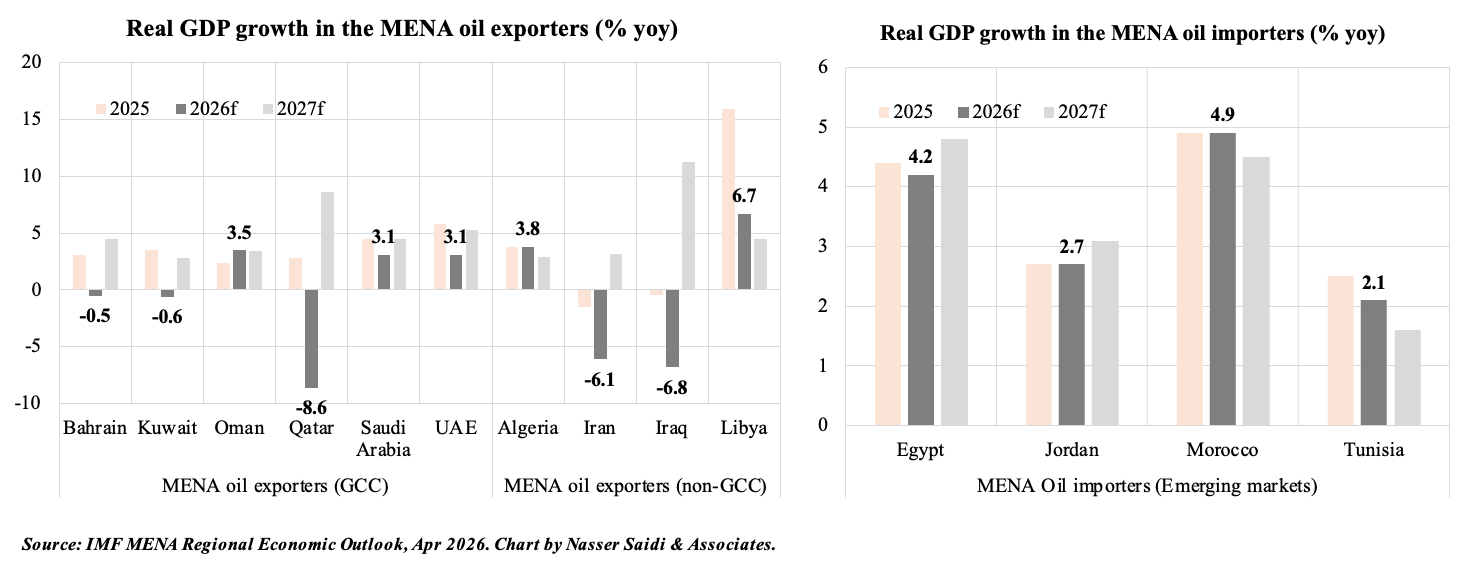
We expect Iran's GDP to shrink by 10.8% this year (we anticipate a 9.4% contraction 3 months ago). Oil production and exports, which provide important revenue and FX inflows, have actually been reduced by the US naval blockade, while non-oil activity has actually been significantly struck. In Iraq, oil exports have actually collapsed to a trickle and we're anticipating GDP to contract by around 22% this year, with a sharp 33% rebound in 2027 as oil exports normalise.
By contrast, Syria continues to reintegrate into the worldwide economy after more than a years of civil war. We expect GDP development to average 9.6% over 2026-2027, supported by renewed financial investment, particularly in banking and energy, monetary reforms, and the steady resuming of regional trade links.
Future Business Landscape of Arabia
The World Bank has actually slashed its 2026 development forecast for Middle East economies, saying overall GDP development in the region is anticipated to slow from an estimated 3.6% in January to 1.8% for 2026. The closure of the tactical Strait of Hormuz, and destruction of energy and public facilities, had actually disrupted markets, increased monetary volatility, and weakened the 2026 development outlook, the World Bank Group stated in its Economic Update for the Middle East, North Africa, Afghanistan and Pakistan.
FDI Dynamics: Predicting the Flow of Capital into 2026The April 2026 World Bank's Macro Hardship Outlook forecasts that the area's aggregate (leaving out the Iran) GDP growth will decelerate to 1.8 percent in 2026, below 4.0 percent approximated for 2025. The 2026 forecast has actually been reduced by 2.4 portion points because the January projections, showing the unfavorable effects of the continuous dispute.
FDI Dynamics: Predicting the Flow of Capital into 2026Saudi Arabia: Projection was downgraded by 1.2 portion points considering that January. Development is now anticipated to slow from 4.3% in 2025 to 3.1% in 2026, keeping in mind that Saudi Arabia's outlook remains the strongest among Gulf economies. United Arab Emirates: Growth forecast for the UAE has fallen by 2.7 portion points considering that January.
Qatar: Notably, growth projection for the Qatari economy has actually seen a sharp decrease of 11.0 portion points since January. The economy is now anticipated to tape-record a contraction of 5.7%, below an estimated growth of 5.3%, due to serious blockage to melted gas materials. Qatar is an essential player in the international energy market, with an international market share of melted gas (LNG) materials ranging between 20% and 21%.
Kuwait relies totally (100%) on the Strait of Hormuz to export its crude oil and derivatives. As a result, closing the strait would indicate a total shutdown of the country's monetary lifeline, immediately halting earnings inflows to the state budget plan. Bahrain: Growth forecast for Bahrain's economy has actually declined by 1.8 percentage points because January.

Latest Posts
Why International Investment Flows Surge in 2026?
Why Foreign Capital Inflows Change in 2026?
Key Stock Market Trends Across the GCC